“Buggy” is one of those words that covers wildly different machines. The same label stretches from a 1960s beach contraption to a Dakar race vehicle, by way of the thing you hire for a guided tour.
There’s no official classification. But if you sort buggies by what they’re built for, six clear families emerge, and between them they cover everything you’ll come across.
1. The dune buggy
The original, the one from the films. It was born in 1960s California and it has a name and a date: Bruce Meyers built the first fibreglass-bodied buggy in 1964, the Meyers Manx, sold as a kit to mount on a Volkswagen Beetle chassis.
That recipe defined the whole family: you start from a road car — almost always the Beetle — and fit a shorter, lighter fibreglass body. The engine sits at the rear, which helps traction, and it’s air-cooled, which keeps the mechanics simple.
It’s a sand and beach vehicle: wide tyres, low weight, open top. On firm ground it doesn’t particularly shine.
2. The sand rail
Here’s the distinction most people miss. A sand rail looks like a dune buggy but isn’t built like one: it doesn’t start from a donor car. It’s fabricated from scratch on a welded steel tube spaceframe — the “rails” it takes its name from — with the roll cage integrated into the structure itself.
You notice it in what’s been left off: no doors, no windows, no wings, barely any bodywork. Just tube, seats and exposed mechanics.
- Weight: between 360 and 680 kg, far below almost any other off-roader.
- Tyres: paddle tyres at the rear to push through sand, smooth or high-flotation at the front so it doesn’t dig in.
- Engine: rear or mid-mounted. The classic choice is the Volkswagen flat-four, though built examples run well past 200 hp.
They’re made for dunes and soft sand, where nothing touches them. On rock they struggle: it isn’t their terrain.
3. The SSV, or side-by-side (the guided-tour one)
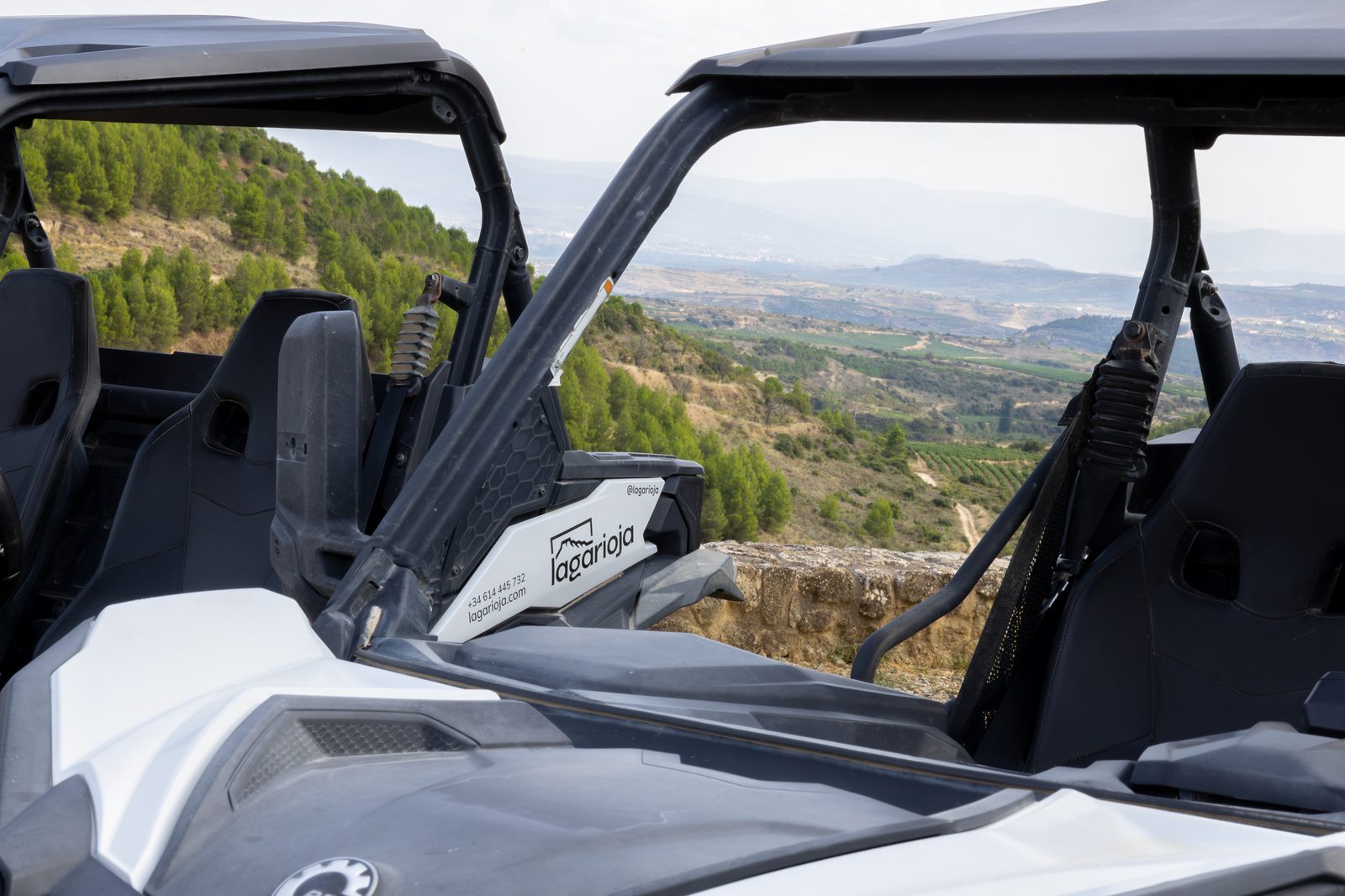
This is the family almost every tourism buggy belongs to, ours included.
The initials stand for Side-by-Side Vehicle: occupants sit next to each other rather than in line. You drive with a steering wheel and pedals, inside a tubular roll-over structure, with seatbelts and long-travel suspension built for rough tracks.
The decisive feature is the transmission: they’re automatic, with no clutch and no gears. That removes the entry barrier for anyone without experience, which is exactly why this is the family used for tours open to the public.
Seats: two, four, six and even eight. The six- and eight-seat versions are usually low-speed shuttle vehicles — golf courses, large venues, resorts — rarely exceeding 25 km/h, so they’re no use on a route.
4. The utility UTV
Utility Task Vehicle. Very similar to the above, but built to work: it carries a cargo bed at the back, towing capacity, and a setup tuned for pulling power and durability rather than fun.
It’s what you see on farms, in wineries, on building sites and golf courses. Same vehicle concept, different purpose.
5. The rock crawler
The most extreme family, and the one least like what you picture when you hear “buggy” — because it’s built to go slowly.
Rock crawling means getting over boulders and rock piles with millimetric precision, and that calls for a very particular machine:
- Enormous gear reduction. Crawl ratios of 100:1 or more, trading speed for torque: the vehicle climbs at walking pace without stalling.
- Huge suspension travel, so all four tyres stay in contact with the ground over impossible terrain.
- Oversized knobbly tyres at low pressure, with beadlocks clamping the tyre to the rim so it can’t unseat.
- Locking differentials and a roll cage welded to the frame.
Power is rarely the limiting factor here. Control is.
6. The race buggy
A different world: competition-homologated safety structures, enormous suspension travel, and vehicles built to a rulebook rather than for a customer. Two variants within this family are worth separating.
The rally-raid buggy
The desert-raid machines, the ones you see flying over dunes at the Dakar. Very high power, range for enormous stages, and budgets in another league. They aren’t rented and they aren’t driven without specific preparation.
The kartcross
Much closer to home, and very much a Spanish and French speciality. A kartcross — or car cross — is a single-seat race car on a small tubular chassis with an integrated roll cage, powered by a large-capacity motorcycle engine, typically 600 cc, driving the rear wheels.
It weighs very little, so its power-to-weight ratio is excellent and it accelerates ferociously on dry dirt. It’s the vehicle raced in the Spanish Autocross Championship and across much of national rallycross, on dirt circuits.
It has nothing in common with a touring buggy: one seat, not road-registered, and driven in a full-face helmet and race gear.
Where our fleet fits
In the third family: recreational SSVs, type-approved and registered for legal road use.
We run two Can-Am models:
Can-Am Maverick Trail — 2 seats. The compact model in the range. It’s narrow, which is exactly what you want on tracks between vines, where the space between rows is what sets the limit. Ideal for couples.
Can-Am Maverick Sport MAX — 4 seats. The four-seat version. For families, groups of friends, or whenever you’d rather all travel in one vehicle instead of splitting up.
Both share what actually matters on a guided route:
- Automatic transmission. Accelerator, brake, steering wheel. That’s it.
- Roll-over protection structure and seatbelts, recorded on the vehicle’s documentation.
- Suspension and traction built for rough tracks.
- An open cabin, no side windows: you hear, smell and feel the place you’re driving through.
Why this family is the right one if you’ve never driven off-road
Three reasons, in order of importance.
There’s nothing to learn. With no clutch and no gearbox, driving comes down to two pedals and a wheel. If you drive an automatic car, you’ll drive this with no transition at all.
The vehicle does the stability work. Unlike a quad, you don’t lean into corners or correct with your body: you sit, belted in, protected by the structure. We go into that in buggy vs quad.
It lets you look around. And that’s the real point. A vehicle that demands constant attention steals the landscape from you; one that drives itself hands it back. After three hours, the difference between having driven through Rioja Alavesa and having seen it is mostly down to this.
Frequently asked questions
Are a buggy and an SSV the same thing? In everyday use, yes. “SSV” is the technical term for the vehicle type; “buggy” is what everyone calls it.
What’s the difference between a dune buggy and a sand rail? Construction. A dune buggy starts from a road car — classically a Volkswagen Beetle — with a fibreglass body fitted. A sand rail is built from scratch on a welded tube chassis, with no bodywork, and weighs considerably less.
And a UTV? The working cousin of the SSV: same concept, but with a cargo bed and a utility focus rather than a recreational one.
Is a kartcross a buggy? Yes, but a racing one. It’s a single-seater on a tubular chassis with a motorcycle engine, usually 600 cc, raced in autocross and rallycross on dirt. It isn’t road-registered and it isn’t made for touring.
How many seats does a buggy have? From two to eight, though the six- and eight-seat versions are usually low-speed shuttles. At LAGA we run two- and four-seaters.
Are all buggies automatic? No. Modern recreational SSVs like ours are, but classic dune buggies, sand rails and race buggies generally aren’t.
What licence do I need? A category B car licence. We explain it fully in what licence you need to drive a buggy in Spain.
It makes more sense from the driver’s seat
👉 See our buggy tours through Rioja Alavesa and Rioja Alta — departures from Laguardia, bookable online.
Ride The Land.