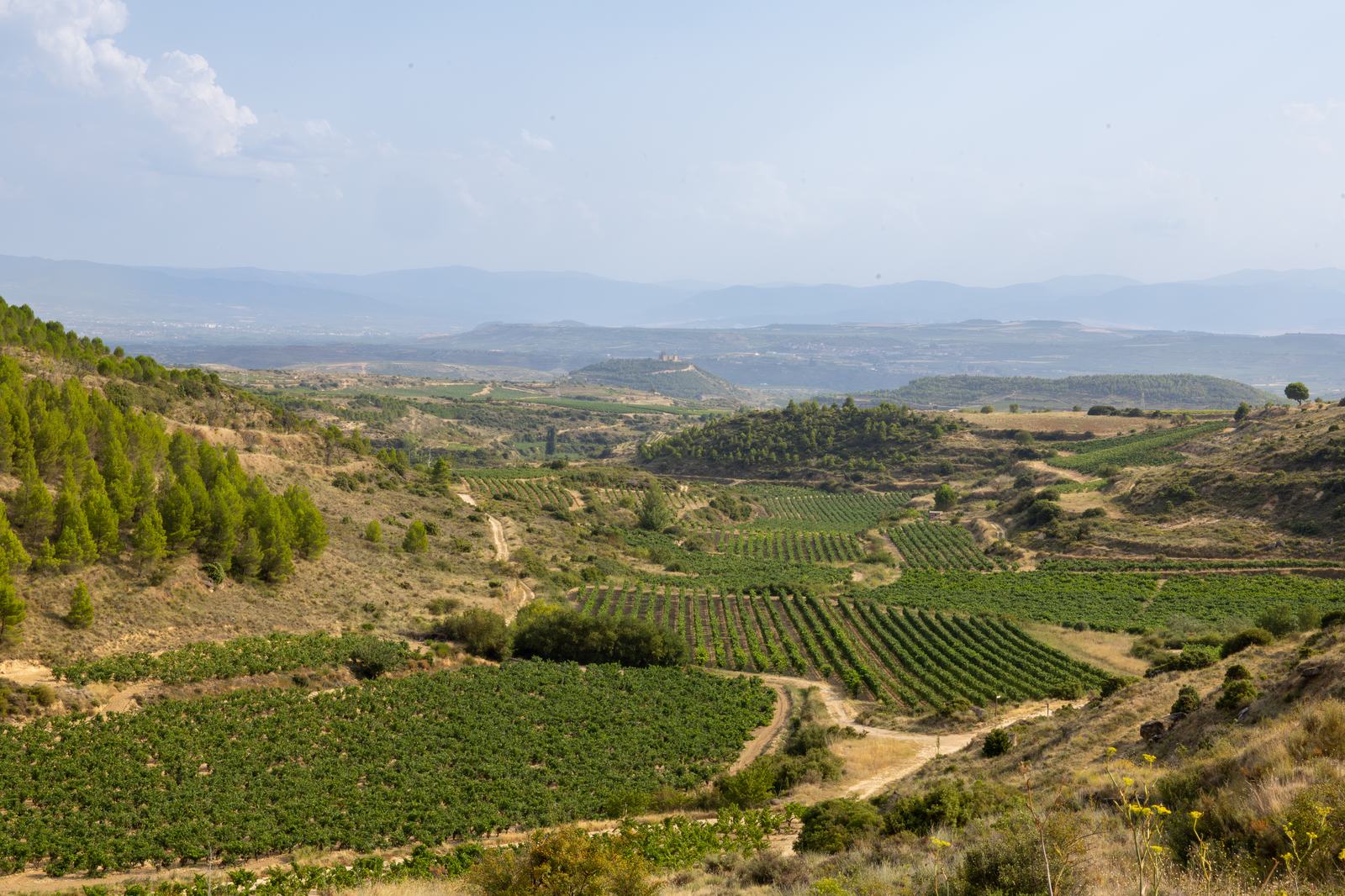
Rioja Alavesa fits into a rectangle of a little over 300 square kilometres between the Sierra de Cantabria and the river Ebro. Inside that small space there are 14,571 hectares of vineyard, 18 municipalities and 219 registered wineries, according to the DOCa Rioja regulatory board. And besides the wine there are megalithic tombs, an Iron Age settlement, walled medieval towns, Romanesque chapels stranded among the vines, and salt lagoons where migrating birds stop.
It is one of the densest corners of Spain in terms of things to see per square kilometre. Here’s how to make sense of it.
Where Rioja Alavesa is, and how to get there
Rioja Alavesa is the Basque part of Rioja wine country: the strip south of the Sierra de Cantabria, on the left bank of the Ebro. Administratively it belongs to Álava, in the Basque Country. Viticulturally it’s Rioja.
Approximate driving times to Laguardia, its capital:
| From | Drive |
|---|---|
| Logroño | 20 min |
| Vitoria-Gasteiz | 45 min |
| Bilbao (and Bilbao airport) | 1 h 15 min |
| Pamplona | 1 h 15 min |
| San Sebastián | 1 h 45 min |
| Madrid | 3 h 30 min |
This makes it a very realistic day trip from Bilbao, and an ideal two-night stop between the Basque coast and Madrid.
The villages
Laguardia
A walled medieval town on a hilltop, with a pedestrian-only historic centre. Its great peculiarity is underground: the subsoil is honeycombed with calados, hand-dug wine cellars sunk several metres below the streets between the 15th and 18th centuries — many still in use, several open to visitors.
Above ground: the church of Santa María de los Reyes, whose 14th-century Gothic doorway retains its original polychrome paint — a genuinely rare survival — and the Portal de Páganos, a natural balcony over the vineyards.
Elciego
The village that became famous because of a building. The pink, gold and silver titanium ribbons of the Marqués de Riscal hotel, designed by Frank Gehry and opened in 2006, sit wedged among the roofs of a 16th-century village. The contrast is the attraction; the San Roque and San Vicente viewpoints are the best places to take it in.
Labastida, Samaniego, Ábalos and Villabuena de Álava
Small stone villages ringed by vines. Labastida has a hilltop viewpoint with 360° views; Samaniego is home to Baigorri, a glass cube at ground level beneath which seven floors of gravity-fed winery are buried; Villabuena has one of the highest concentrations of wineries per inhabitant in all of Rioja.
San Vicente de la Sonsierra
Technically across the border in La Rioja, but part of the same landscape. Its castle and tower dominate the Ebro from above.
Three centuries of wine architecture
Rioja Alavesa lets you see the entire evolution of wine building within a few kilometres:
- The calados of Laguardia (15th–18th c.) — wine underground, the solution before electricity.
- The stone family bodegas of the 19th and 20th centuries, inside the villages.
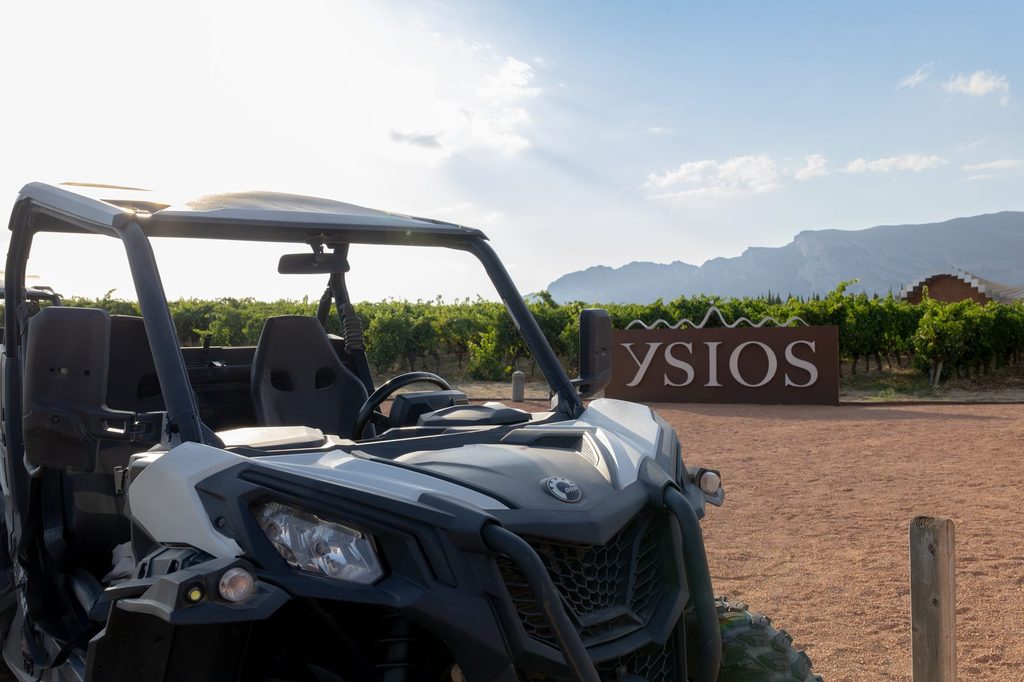
- The star-architect wineries of the 21st century — Ysios (Calatrava, 2001), whose wave-form aluminium roof echoes the mountain ridge behind it; Marqués de Riscal (Gehry, 2006); Baigorri (Samaniego).
Practical note: almost every winery here requires advance booking and works to fixed tour times. If you’re coming at a weekend, reserve days ahead — turning up without a booking usually means not getting in.
Prehistory among the vines
This is the part most visitors don’t expect, and arguably the most extraordinary thing about the region.
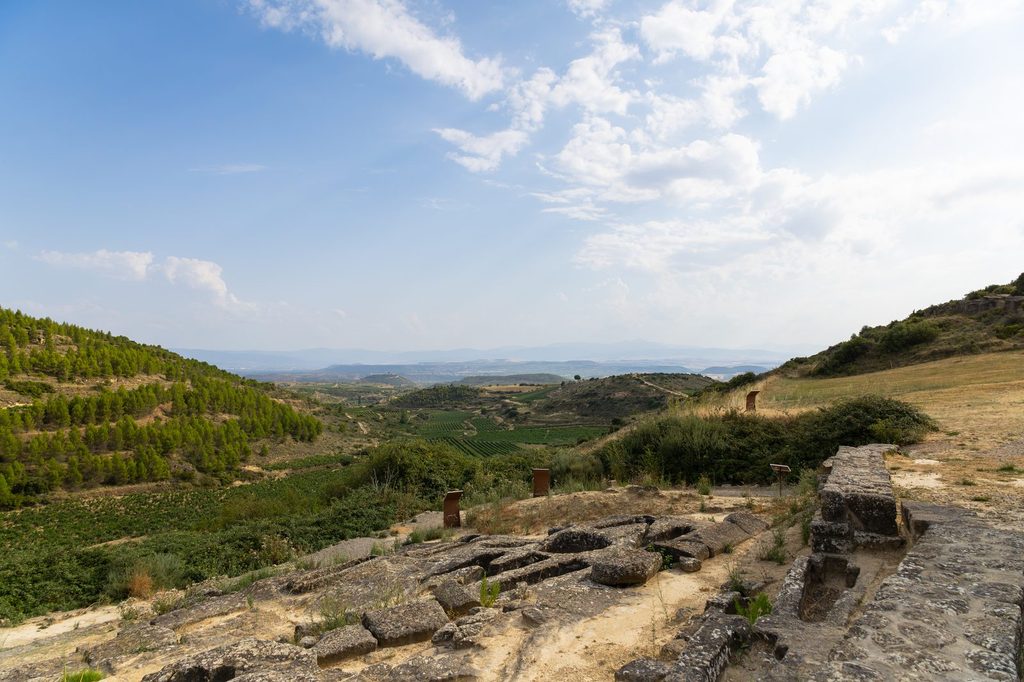
- The Alto de la Huesera dolmen (Laguardia): a passage tomb with an eight-metre corridor under a mound some twenty metres across, built around 4,500–5,000 years ago. Excavations documented the remains of over a hundred individuals alongside flint arrowheads, pottery and a unique anthropomorphic stele. Restored, protected, and reached by dirt track between working vineyards.
- The Rioja Alavesa Dolmen Route, linking several more megalithic tombs — La Chabola de la Hechicera, in Elvillar, is the most monumental.
- La Hoya settlement (Laguardia): a Bronze Age and Iron Age village, excavated and open to visitors, with a museum on the site. You can walk the ground plans of the houses.
- The hermitage of Santa María de la Piscina (San Vicente de la Sonsierra): completed in 1136, consecrated on 1 August 1137, and considered the best-preserved Romanesque building in La Rioja. It stands alone in open country beside a medieval necropolis cut into the rock.
Viewpoints
- El Balcón de la Rioja, next to the Puerto de Herrera pass, at around 1,000 m — the region’s signature panorama, taking in the whole vineyard mosaic down to the Ebro.
- Portal de Páganos (Laguardia), best at sunset.
- San Roque and San Vicente (Elciego), for the Marqués de Riscal shot.
- Mirador de San Ginés (Lapuebla de Labarca), over a bend in the Ebro.
Nature: the Laguardia lagoon complex
Just outside Laguardia lies a protected biotope of several endorheic, brackish lagoons — an unusual ecosystem this far north in Spain, and a stopover for migrating birds. An easy circular path runs around them. In spring, with water and birdlife, it’s a short detour that repays itself.
A weekend in Rioja Alavesa
Saturday morning — Laguardia: the walled centre, the polychrome doorway of Santa María de los Reyes, and an underground calado.
Saturday lunch — eat in one of the small villages (Villabuena, Samaniego, Ábalos), then a pre-booked winery visit.
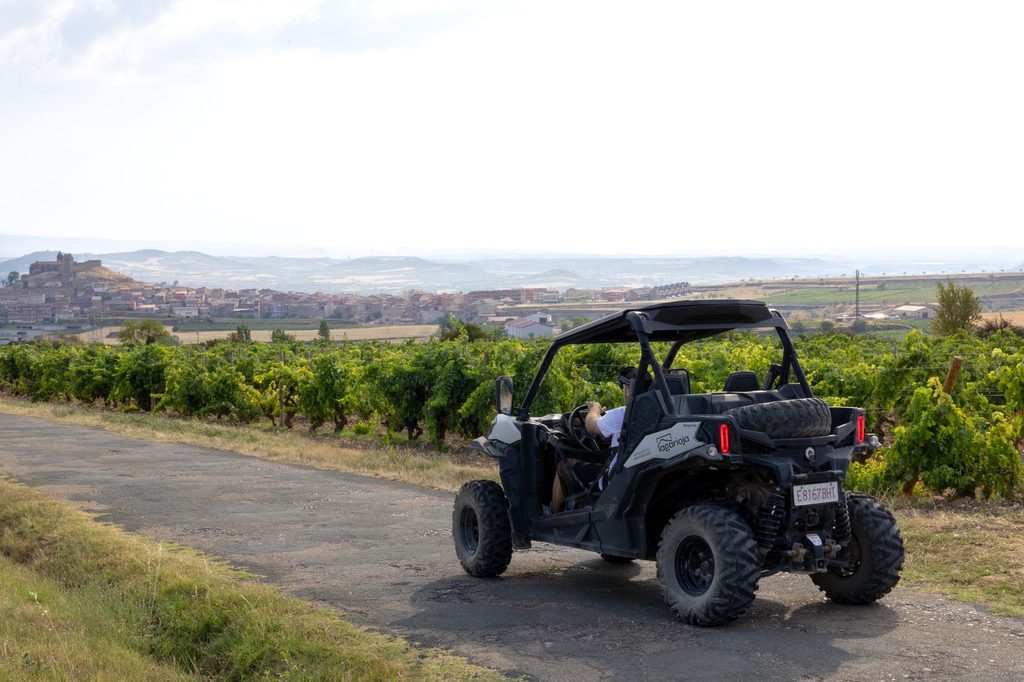
Saturday afternoon — a buggy tour along the tracks between the vines: the Alto de la Huesera dolmen, the Elciego viewpoint, Ysios, and — on the longer route — a crossing into Rioja Alta to Santa María de la Piscina and the Balcón de la Rioja in the late afternoon light. It’s how you see, in three hours, the part of the region cars can’t reach.
Sunday morning — Elciego and Marqués de Riscal, or La Hoya and the lagoons if you’re travelling with children.
Sunday lunch — a long one in Laguardia, then home.
When to visit
- Spring (April–June): green vines, full lagoons, mild weather.
- Summer (July–August): genuinely hot at midday — plan outdoor activities early or late.
- Autumn (September–October): harvest, and the vine leaves turning red and gold. Visually the best time of year by a distance.
- Winter (November–March): bare vines, clear air, snow on the sierra and no queues.
Frequently asked questions
How many days do I need? A weekend covers the essentials; three days lets you add more wineries, the Dolmen Route and a walk in the Sierra de Cantabria.
Can I visit Rioja Alavesa without a car? It’s difficult. Public transport between villages is sparse and the best sites are outside the villages. The practical solution is to stay in Laguardia and book activities and transfers from there.
Is it good for children? Yes. La Hoya, the lagoons, the dolmens and Laguardia’s walls all work well with kids. On our buggy tours children can ride as passengers from age 4.
Is Rioja Alavesa the same as La Rioja? Not quite. Rioja Alavesa is one of the three zones of DOCa Rioja (with Rioja Alta and Rioja Oriental), but it belongs administratively to the Basque Country.
See it from inside the vineyard
Almost everything in this guide — the dolmen, the chapels, the viewpoints, the tracks between the plots — sits off the main road. That’s why so many people drive through the region without ever really seeing it.
👉 Explore our buggy tours through Rioja Alavesa and Rioja Alta — daily departures from Laguardia, with a guide and a local produce tasting.
Ride The Land.