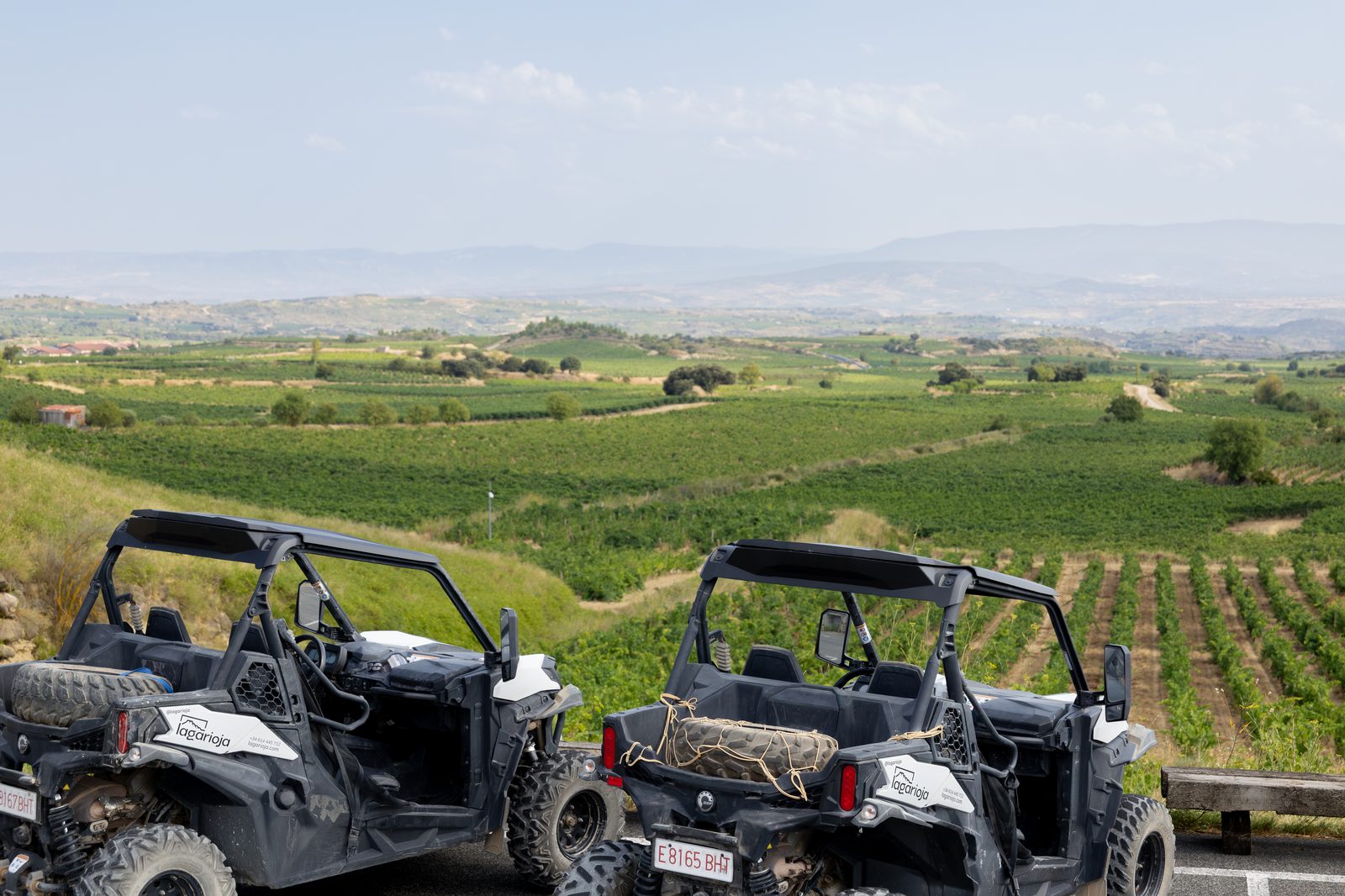
Wine tourism in Rioja has run on the same formula for twenty years. You book a winery, you follow a guide past the barrel hall, you taste in a purpose-built room, you buy a bottle in the shop. It works. And by the third winery, they all start to blur.
The problem isn’t the winery visit. It’s that the winery is the end of the process, not the place. The wine here isn’t explained in a stainless-steel hall: it’s explained by a clay-limestone soil that covers 95% of the region’s vineyard, by a mountain range over 1,400 metres high acting as a shield against the north, and by 14,571 hectares of vines planted between medieval villages.
Here are eight ways to experience Rioja Alavesa from that other side.
1. Get physically inside the vineyard
The image everyone has of Rioja — the sea of vines rolling up to the mountains — is a view from the road. But the region is threaded with hundreds of kilometres of farm tracks, built so tractors can reach the plots, that lead to places tarmac never reaches: isolated hilltops, chapels with no village, viewpoints approached from above.
Driving them by buggy, with a guide, changes the scale of a visit entirely. In two or three hours you cross several municipalities, stop wherever it’s worth stopping, and see the vineyard from inside rather than from the verge.
2. Go down into a 16th-century calado in Laguardia
Beneath Laguardia’s medieval centre there is a second town: dozens of calados, wine cellars dug by hand between the 15th and 18th centuries, several metres down, holding a constant temperature year-round. Many are still working cellars.
It’s a completely different experience from a modern winery tour: low ceilings, damp air, the smell, and the physical sense of why wine here was made underground for centuries — because there was no other way to keep it cool.
3. Drink the wine from the wineries you’ve just driven past
On a conventional visit this is what happens: you taste a wine and you’re told where it comes from, but that origin stays abstract. You’ve seen a barrel hall, not the place.
Here the order is reversed. First you cross the territory — passing wineries, skirting their plots, seeing them from the track with the mountains behind — and only then do you sit down to taste. By the time the bottle is opened you already know where it came from: you drove past it an hour ago.
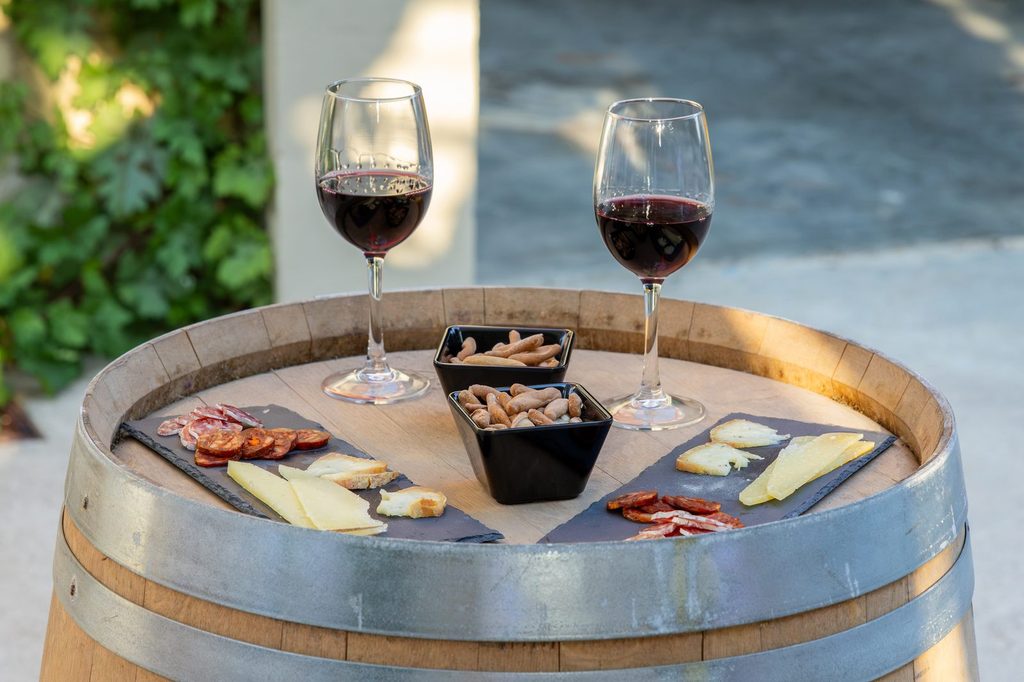
Our tasting happens at the end of the route, outside our base, and everything on the table is local produce: DOCa Rioja wine from nearby wineries, cheese, cured meat and artisan bread. It’s the moment most people remember afterwards — not so much for the wine itself as because, by then, you understand what you’re drinking.
4. Come during harvest
Between late August and mid-October the region changes tempo: picking crews in the vineyards at dawn, trailers of grapes on the back roads, the smell of fermentation drifting through the villages. The 2026 campaign started unusually early, with general picking under way by mid-September.
You don’t have to pick grapes to experience it. You just have to be here in those weeks and get out among the tracks — it’s the only time of year you can watch this landscape actually working.
5. Look for the dolmens between the vines
Metres from vines in full production stand burial chambers built 4,500–5,000 years ago. The Alto de la Huesera dolmen, in Laguardia, has an eight-metre corridor and yielded the remains of more than a hundred people. La Chabola de la Hechicera, in Elvillar, is the most monumental in the region.
The juxtaposition is the point: the same ground has been occupied by people for five millennia, and today it makes wine.
6. Get to a viewpoint at the right hour
El Balcón de la Rioja, beside the Puerto de Herrera pass, sits at around 1,000 metres and takes in the entire region in one sweep. The Portal de Páganos in Laguardia and the San Roque and San Vicente viewpoints in Elciego — with Gehry’s hotel glinting among the roof tiles — are best at sunset.
One tip: golden hour here is short and it transforms everything. If you only make one panoramic stop, make it the last hour of light.
7. Treat the wine architecture as an itinerary
Within a few kilometres you have three centuries of winery building:
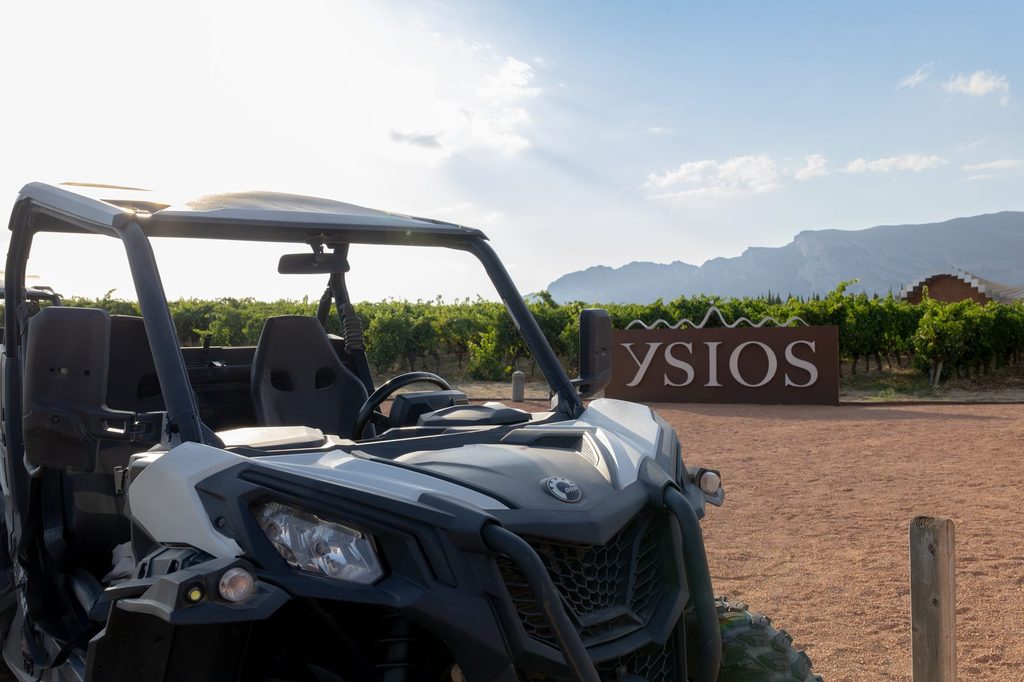
- Ysios (Laguardia) — Santiago Calatrava’s undulating 2001 roofline, drawn to echo the Sierra de Cantabria behind it.
- Marqués de Riscal (Elciego) — Frank Gehry’s titanium hotel of 2006, dropped into a 16th-century village.
- Baigorri (Samaniego) — a glass cube above seven buried floors of gravity-fed winery.
Doing all three in a day, even just from the outside, is a perfectly valid way to spend it.
8. Go down to the Ebro and the lagoons
Rioja Alavesa isn’t only vineyard. Lower down, the Ebro loops into meanders and river islands, visible from the viewpoints at Lapuebla de Labarca and Baños de Ebro. And just outside Laguardia sits a protected lagoon complex — brackish endorheic pools with an easy circular trail and migrating birds in spring and autumn.
They’re the two natural faces of a region usually sold on wine alone.
Fitting it into a weekend
| Morning | Afternoon | |
|---|---|---|
| Saturday | Laguardia: walled town and an underground calado | Buggy tour: vineyards, dolmen, viewpoints and a tasting to finish |
| Sunday | A pre-booked architect-designed winery | Elciego and Marqués de Riscal, or the lagoons and La Hoya |
The key is not to stack three winery visits into one day. Alternating cellar, territory and landscape is what makes a weekend here memorable.
Frequently asked questions
Do I need to know about wine? No. The experiences on this list work particularly well for people who don’t, because they explain wine through landscape rather than vocabulary.
Is Rioja Alavesa good for families? Yes, as long as the plan isn’t only tastings. Dolmens, the La Hoya settlement, the lagoons, the town walls and a buggy tour — children ride as passengers from age 4 — all work well.
When is the best time of year? September and October, for the harvest and the colour of the vines. May and June come second: green countryside, fewer people.
Can I do all this without my own car? Public transport between villages is limited. The practical approach is to base yourself in Laguardia or Elciego and book activities with a village meeting point.
Do you host corporate groups or celebrations? Yes — it’s one of our most requested formats: territory, activity and tasting in a single three-hour block. Get in touch and we’ll build it around you.
Start with the vineyard
Of the eight, one underpins all the others: get off the road. Almost everything that makes this region special — the dolmens, the chapels, the viewpoints, the old plots — is out on the tracks.
👉 See our buggy tours through Rioja Alavesa and Rioja Alta — two routes, our own guides, and a local produce tasting to finish, bookable online.
Read next: things to do in Rioja Alavesa and what makes Rioja Alavesa and Rioja Alta different.
Ride The Land.